The phrase “latest IOL” covers several lens designs, each aimed at a different range of vision and carrying different compromises. By comparing those designs with your reading habits, night-driving needs, astigmatism and eye health, you can reach a more useful discussion with your surgeon than by choosing a lens based on its marketing name.
Key takeaways
- Choose an IOL for your visual priorities, not because it is labelled latest.
- Tell your surgeon how much near, intermediate and distance work you do.
- Biometry and corneal measurements determine the lens power and surgical plan.
- Compare surgeon experience, diagnostic testing, counselling and follow-up before booking.
What does “latest IOL” mean in cataract surgery?
“Latest IOL” means a current intraocular lens design selected for a specific visual target, not one universally superior product. Each option prioritises a different balance between distance, intermediate vision, near work, optical quality and glasses use.
1. A monofocal IOL gives the most predictable focus at one chosen distance, usually far vision. Reading glasses commonly remain necessary, and choosing this lens is not an outdated fallback.
2. A toric IOL corrects regular corneal astigmatism during cataract surgery. Reliable measurements and accurate rotational alignment matter; irregular astigmatism, poor measurements or lens rotation can leave residual blur.
3. An enhanced-monofocal IOL extends useful focus beyond a conventional monofocal lens, often improving intermediate vision for dashboards or computer screens while retaining a relatively familiar optical profile.
4. An extended-depth-of-focus, or EDOF, IOL aims to provide distance and intermediate vision across a broader range. It is not simply a stronger multifocal lens, so close reading may still require glasses.
5. Multifocal and trifocal IOLs divide light between multiple focal points to reduce dependence on glasses for distance, computer work and near tasks. Halos, glare, reduced contrast and night-vision symptoms are possible trade-offs.
None guarantees spectacle independence. Before cataract surgery with latest IOL in Chandigarh, ask for each eye’s focal target, expected glasses use and the plan if the postoperative prescription differs. That documented match—not the phrase latest IOL cataract surgery in Chandigarh—should guide the decision.
Which IOL suits your eyes, work and daily routine?
Your daily routine should decide the lens, not the word “latest.” A driver who works at night may value contrast and freedom from halos more than freedom from reading glasses, making a monofocal IOL the better choice.
| Option | Best fit | Main compromise |
|---|---|---|
| Monofocal | Distance-focused vision, night driving, or greater tolerance for glasses | Reading or computer glasses often remain necessary |
| Toric IOL | Regular corneal astigmatism measured reliably before surgery | Residual blur can follow unreliable measurements, irregular astigmatism or lens rotation |
| Enhanced-monofocal or EDOF | Intermediate tasks such as computer work, with some extended focus | Close reading may still need glasses; halos or glare can occur |
| Multifocal or trifocal | Strong desire to reduce glasses for distance, computer and near work | Halos, glare, reduced contrast and night-vision symptoms; no guarantee of spectacle independence |
Extensive readers, computer users and people who strongly dislike glasses can discuss an enhanced-monofocal, EDOF, multifocal or trifocal lens with a cataract surgeon in Chandigarh. Choose based on the actual reading distance and night-driving demands, not on the lens label.
Dry eye, corneal scarring or irregularity, glaucoma, optic-nerve disease, macular degeneration, diabetic retinal disease, amblyopia and other retinal problems can limit a premium lens. Treating the ocular surface first can improve measurements and visual quality.
Ask for the intended focal target in each eye, expected glasses use, measured astigmatism and the correction plan if the result misses target. A spherical monofocal lens or limbal-relaxing incisions can be wiser than a toric lens when astigmatism is irregular. Choosing monofocal vision is a deliberate clinical decision, not an outdated fallback.
What tests determine whether you are ready and which lens power you need?
Readiness for surgery depends on functional impairment, not whether the cataract has become fully opaque. Difficulty reading, driving, recognising faces, working or managing glare can justify surgery when the surgeon confirms that the cataract is responsible.
The examination usually includes:
| Test | What it measures | Why it matters |
|---|---|---|
| Visual acuity | Distance and near clarity | Documents functional vision |
| Refraction | The glasses power needed | Separates cataract blur from focusing error |
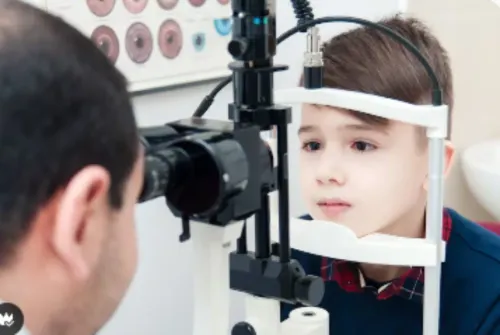
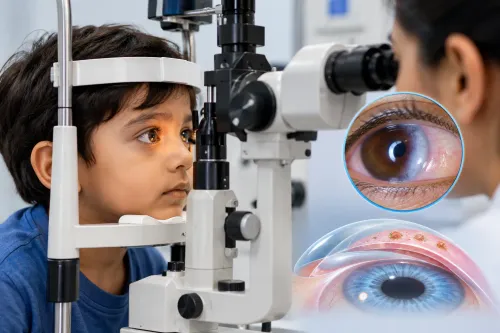
| Slit-lamp examination | Cataract, cornea and front-of-eye health | Confirms the lens and ocular surface findings |
| Dilated retinal examination | Retina, optic nerve and macula | Finds disease that could limit recovery |
| Optical biometry | Axial length and other eye dimensions | Calculates IOL power |
| Keratometry | Corneal curvature and power | Measures astigmatism and supports lens selection |
| Topography or tomography | Corneal shape and irregularity | Investigates irregular astigmatism and toric-lens suitability |
Treat dry eye, unstable tears or other ocular-surface problems before final measurements; a poor tear film can produce an unreliable result. Request a macular scan when you have diabetes, retinal disease, reduced vision or unexplained symptoms.
Tell the surgeon about previous LASIK or PRK. Bring old glasses prescriptions, operative records and historical corneal data because IOL calculations become less predictable after laser vision correction.
Before surgery, confirm that the record states:
- Target refraction for each eye
- Measured astigmatism and proposed IOL type
- Expected need for glasses
- Options if the postoperative power misses the target, including glasses, laser enhancement or another correction
What happens on the day of cataract surgery?
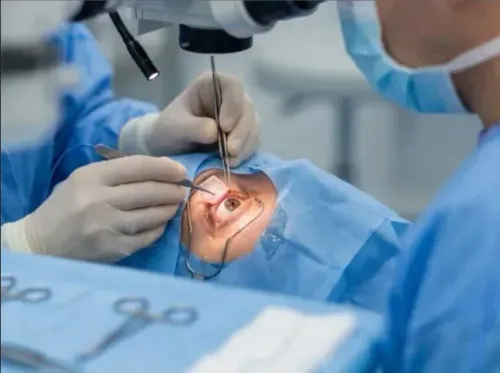
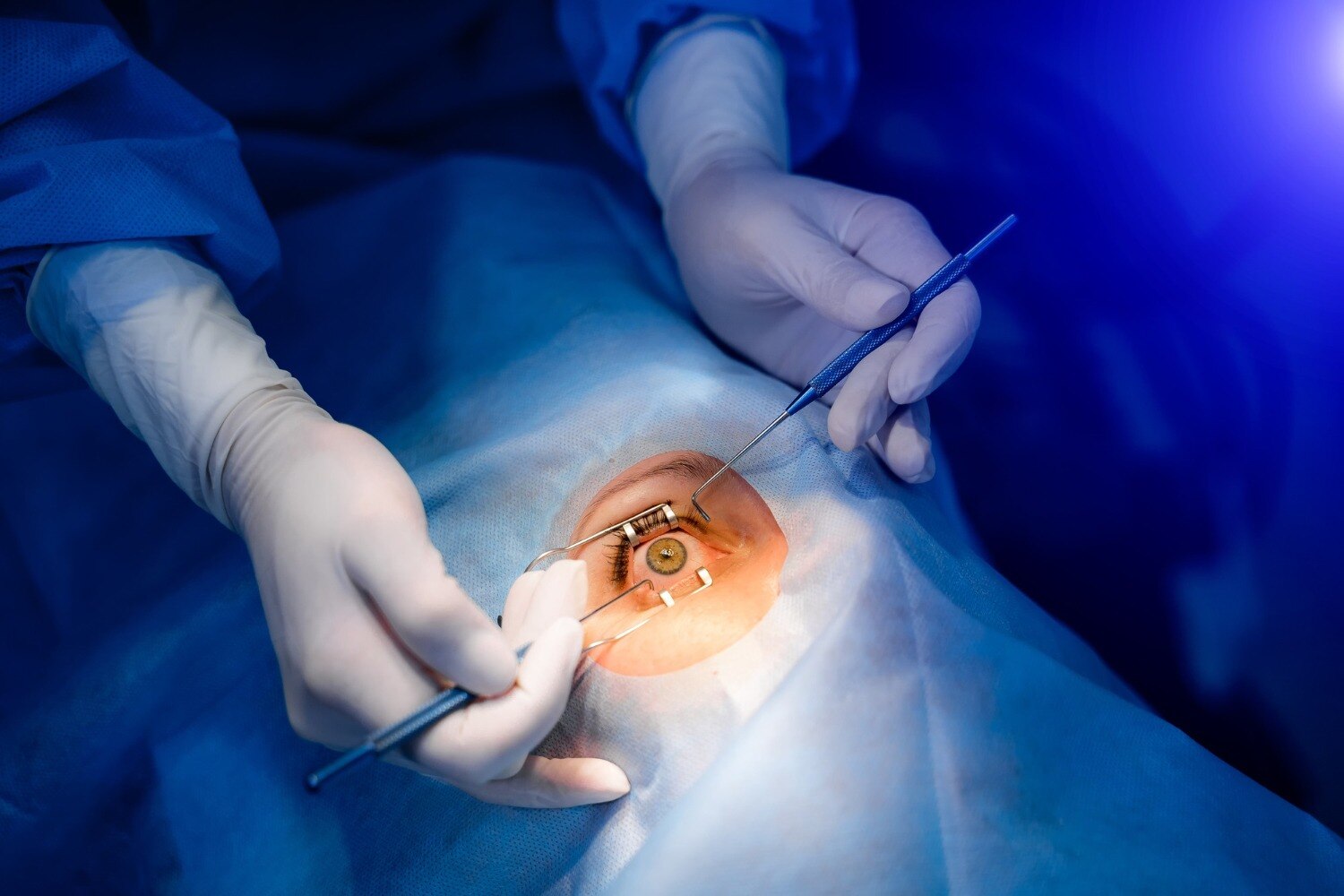
On the day of surgery, phacoemulsification removes the cloudy natural lens through a small corneal incision. The surgeon breaks the lens into fragments, removes them, and places the selected intraocular lens (IOL) inside the remaining lens capsule.
Topical anaesthetic drops or local anaesthesia keep the eye comfortable; the exact plan depends on your health, the operation and hospital protocol. Laser-assisted cataract surgery can automate or assist selected steps, but it does not replace the IOL. Phacoemulsification is the lens-removal method; the IOL determines your optical focus afterward.
Most patients go home the same day after recovery checks. Before leaving, confirm:
- Which medicines to use, how often to use them and when to start
- The emergency contact route for severe pain, worsening vision, marked redness, flashes or a curtain-like shadow
- The date and timing of the first review
- Whether both eyes will be treated separately and how the interval will be decided
Do not assume that both eyes will be operated on together. The surgeon will set the timing according to your eye health, recovery and hospital protocol.
Months or years later, posterior capsule opacification can cloud vision behind the IOL. It is usually treated with YAG laser capsulotomy, which clears the capsule without replacing the IOL.
How should you compare a cataract surgeon and hospital in Chandigarh?
Compare a cataract surgeon in Chandigarh by the assessment and follow-up they document, not by an advertised IOL brand or the word “laser.” A cataract surgery hospital near me should show how measurements support the lens choice and how urgent problems will be handled.
| Check | Ask for | Why it matters |
|---|---|---|
| Biometry and corneal testing | Written axial-length biometry, keratometry, ocular-surface assessment and, where needed, topography or tomography | Unstable tear film or irregular astigmatism can produce the wrong IOL power or residual blur |
| Retinal evaluation | Dilated retinal examination and macular OCT when diabetes, reduced vision, retinal symptoms or unexplained findings exist | Macular disease can limit the result even when surgery is technically successful |
| Toric planning | Recorded corneal astigmatism, planned toric axis and a method for confirming lens alignment | A rotating toric IOL or unreliable measurements can leave astigmatism after surgery |
| Follow-up access | A named urgent review route for pain, worsening vision, marked redness or new flashes | These symptoms need prompt assessment, not a routine appointment |
Ask the surgeon to state the focal target for each eye, expected spectacle use, night-vision trade-offs and the plan for residual astigmatism. The discussion should explain why a monofocal, toric, enhanced-monofocal, EDOF or multifocal IOL fits your eyes and routine.
Request a written estimate naming the IOL, surgery, medicines, follow-up visits and enhancement or correction charges. Advanced Squint Centre can be compared with other Chandigarh facilities using these same checks.
Related services
Cataract Surgery with Latest IOLs Cataract Surgery with Latest IOLs Advanced Squint Centre offers advanced Cataract Surgery with Latest IOLs in Chandigarh, providing patients with safe, effective, and modern vision... View service → |
Secondary IOL (SF-IOL) Advanced Squint Centre offers advanced Secondary IOL (SF-IOL) Surgery in Chandigarh for patients who require intraocular lens implantation when... View service → |
Frequently asked questions
What does “latest IOL” mean in cataract surgery?
It means a current intraocular lens design selected for a specific visual target. No IOL is universally best; each balances distance, intermediate vision, near work, optical quality and glasses use differently.
Which IOL suits my eyes, work and daily routine?
Your choice depends on your preferred vision range, reading and screen use, night driving, eye health and tolerance for glasses or optical effects such as glare and halos.
What tests determine whether I am ready and which lens power I need?
Your assessment can include a slit-lamp examination, dilated retinal examination, corneal measurements, optical biometry and ocular-surface evaluation. These findings help calculate IOL power and identify conditions that affect results.
What happens on the day of cataract surgery?
The team confirms your identity, eye and surgical plan, prepares the eye, administers anaesthesia, removes the cloudy natural lens, inserts the IOL and gives postoperative instructions before discharge.
How should I compare a cataract surgeon and hospital in Chandigarh?
Compare the surgeon’s relevant experience, the hospital’s diagnostic equipment, lens-selection counselling, infection-control processes, emergency arrangements, written costs and follow-up plan.
Keywords