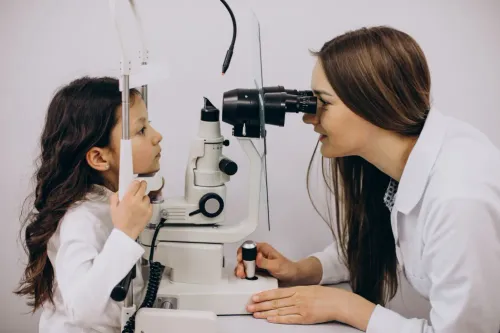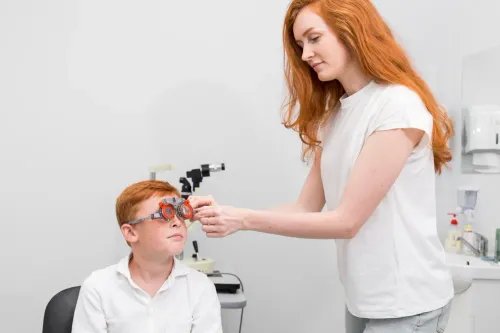
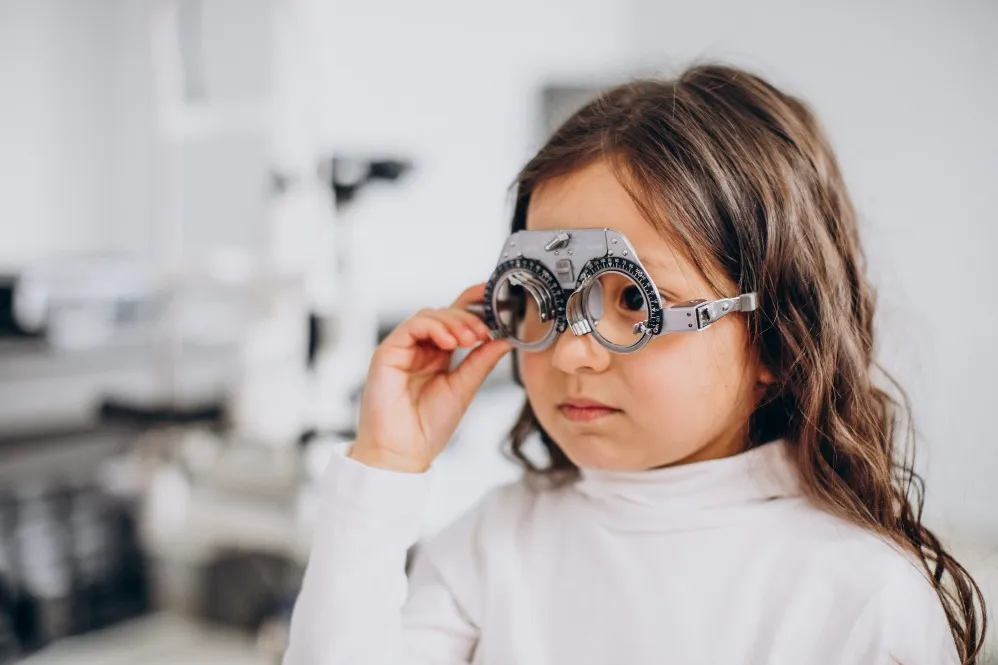
When a child can read a book comfortably but struggles to recognise writing on the classroom board, myopia or short-sightedness may be responsible. Myopia commonly begins during childhood and can progress as the eyes continue to grow.
For school-going children in Chandigarh, increased educational demands and substantial amounts of near work make regular vision assessment particularly relevant when distance vision begins to change.
What exactly is childhood myopia?
In a myopic eye, light focuses in front of the retina rather than directly on it. As a result, nearby objects may remain clear while distant objects appear blurred.
A child may not always say that their eyesight has changed. Instead, parents and teachers may notice behavioural clues such as:
- Sitting unusually close to a television
- Moving closer to the classroom board
- Holding objects close to the face
- Squinting while looking into the distance
- Difficulty recognising people from far away
- Frequent changes in spectacle prescription
A comprehensive eye examination can determine whether these behaviours are related to myopia or another visual issue.
Correcting vision and managing progression are different
Regular prescription glasses correct blurred vision while they are being worn. Myopia-management strategies have a different objective: they may be considered in appropriate children to help slow progression.
Depending on age, prescription, eye measurements and individual suitability, an ophthalmologist may discuss options such as specialised spectacle lenses, particular contact-lens approaches or low-dose atropine.
No single strategy is suitable for every child. Follow-up examinations remain important because myopia can change as a child grows.
Everyday habits still matter
Parents can also encourage healthier visual routines.
Children should have opportunities to spend time outdoors and take regular breaks from prolonged close-up activities. Reading and digital devices should be used at a comfortable working distance rather than extremely close to the face.
These habits should complement rather than replace prescribed glasses or clinical myopia management.
Myopia care for children in Chandigarh
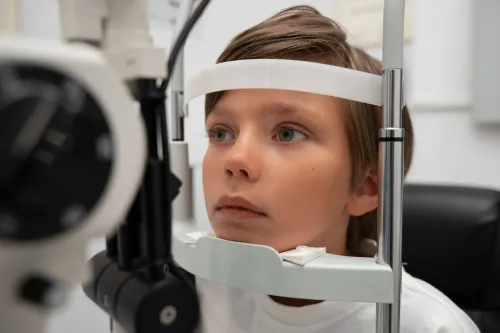
At Eye Care 22 in Chandigarh, childhood myopia assessment can include checking visual acuity, refractive error and other relevant aspects of ocular health before an individual management plan is considered.
The aim should not be to promise that myopia can be permanently “frozen.” Instead, families need realistic guidance on clear vision, monitoring progression and determining whether a myopia-control approach is appropriate.
If a child is repeatedly struggling with distance vision or their spectacle power appears to be changing frequently, a detailed pediatric eye examination can provide clearer answers and establish an appropriate follow-up plan.
Keywords