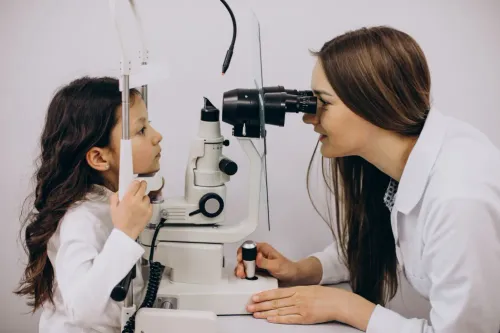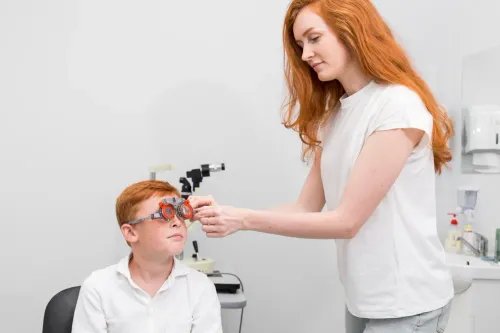
A child or teenager whose spectacle prescription keeps changing may simply have a progressing refractive error. In some cases, however, increasing astigmatism or deteriorating visual quality can prompt investigation for keratoconus or another form of corneal ectasia.
Keratoconus occurs when the cornea gradually becomes thinner and develops an increasingly irregular shape. Instead of maintaining a regular curved surface, the cornea can become more cone-like, producing distorted or blurred vision.
What signs can suggest keratoconus?
Children and teenagers may report:
- Increasingly blurred vision
- Distorted images
- Frequent spectacle prescription changes
- Increasing astigmatism
- Glare or visual difficulty around lights
- Reduced quality of vision despite new glasses
Some children may have few obvious complaints, particularly when one eye is more affected than the other.
Persistent eye rubbing can also be clinically relevant, particularly in children with ocular allergy. Managing allergy and discouraging vigorous rubbing can therefore form part of corneal care.
Why is corneal mapping important?
An ordinary spectacle test tells the clinician about refractive error but does not provide a detailed map of corneal shape.
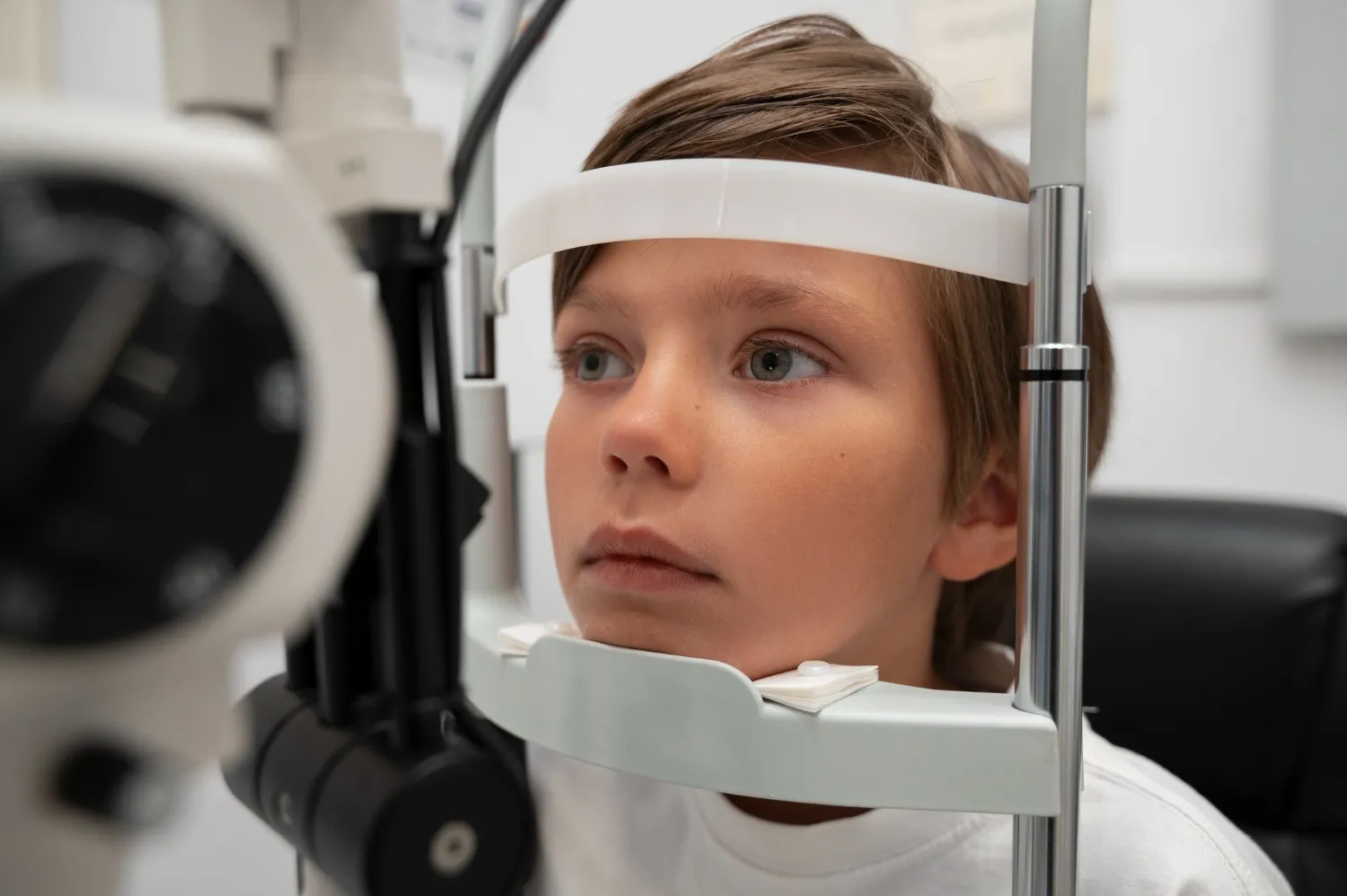
When keratoconus or ectasia is suspected, corneal topography or tomography can provide more detailed information about curvature, symmetry and structural characteristics.
Repeated measurements can also help determine whether the condition is stable or progressing.
Glasses and progression management have different roles
In earlier disease, glasses or selected contact lenses may improve visual clarity. More irregular corneal shapes can require specialised contact lenses for better optical correction.
When documented progression is present, the ophthalmologist may consider corneal cross-linking in suitable patients. Its role is different from simply prescribing stronger spectacles: the aim is to strengthen corneal tissue and reduce further progression.
Suitability depends on the individual clinical findings.
Keratoconus evaluation in Chandigarh
Eye Care 22 provides pediatric corneal evaluation in Chandigarh for children and adolescents with unexplained visual deterioration, increasing astigmatism or suspected corneal-shape abnormalities.
Parents may consider a more detailed corneal assessment when a child’s vision remains unsatisfactory despite updated spectacles, prescription changes are unusually frequent or there is a relevant family history.
Early identification provides an opportunity to document the cornea carefully, manage associated problems such as allergy and determine whether observation, optical correction or another intervention is appropriate.
For young patients, the goal is an individual plan based on measurable corneal findings rather than relying solely on changing spectacle power.
Keywords